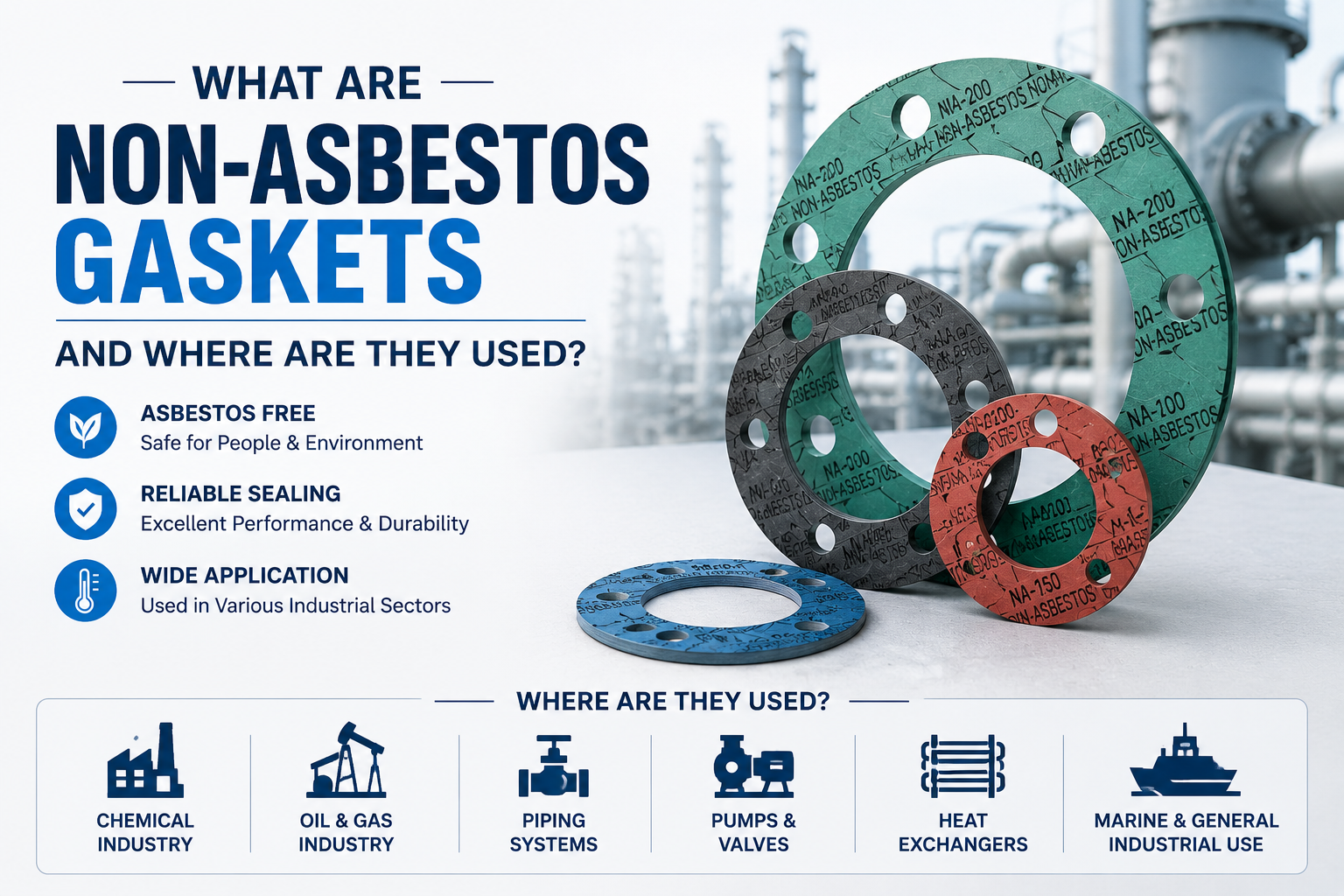
Non-asbestos gaskets are industrial sealing materials manufactured without asbestos fibers. They are commonly produced using combinations of synthetic fibers,
Non-asbestos gaskets are industrial sealing materials manufactured without asbestos fibers. They are commonly produced using combinations of synthetic fibers, elastomeric binders, and fillers engineered to provide reliable sealing performance under various temperature, pressure, and chemical service conditions.
These gaskets are widely used as alternatives to traditional compressed asbestos fiber gaskets and are available in different grades depending on the intended industrial application.
What Is a Non-Asbestos Gasket?
A non-asbestos gasket is generally manufactured from compressed synthetic fiber materials combined with rubber or other suitable binders. Depending on the grade, reinforcement materials may include aramid fibers, mineral fibers, cellulose fibers, or other engineered materials.
The exact composition determines important characteristics such as temperature resistance, pressure capability, chemical compatibility, compressibility, and recovery.
For this reason, not every non-asbestos gasket is suitable for every application.
1. Why Are Non-Asbestos Gaskets Used?
Non-asbestos gasket materials were developed to provide industrial sealing without using asbestos fibers.
Modern non-asbestos gasket sheets can provide dependable sealing performance for many flange, piping, equipment, and machinery applications.
Their main advantages can include:
- Asbestos-free construction
- Good sealing characteristics
- Availability in multiple material grades
- Resistance to various oils, water, gases, and chemicals depending on grade
- Suitable temperature and pressure capability depending on material
- Easy fabrication into different gasket shapes and sizes
- Availability for standard and customized requirements
Actual performance depends on the selected gasket grade and operating conditions.
2. What Materials Are Used in Non-Asbestos Gaskets?
Non-asbestos gasket materials can contain different combinations of synthetic fibers, fillers, and elastomeric binders.
Common formulations may incorporate materials such as aramid fibers, mineral fibers, cellulose fibers, NBR and other suitable elastomers.
The formulation varies according to the manufacturer and product grade.
Therefore, buyers should check the technical datasheet rather than assuming that all non-asbestos sheets have identical properties.
3. Chemical Processing Industries
Non-asbestos gaskets can be used in chemical processing equipment where the selected gasket grade is compatible with the process media.
Typical applications may include:
- Pipe flanges
- Pumps
- Valves
- Process equipment
- Utility lines
- Selected chemical handling systems
Chemical compatibility must be verified against the specific fluid, concentration, temperature, and pressure.
4. Oil & Gas Applications
Suitable non-asbestos gasket grades can be used in various oil and gas-related applications.
They may be considered for systems handling oils, fuels, lubricants, water, and certain gases, depending on the material specification.
Because operating conditions in oil and gas facilities can vary considerably, gasket selection should always follow the relevant engineering requirements.
5. Piping Systems
One of the most common applications for non-asbestos gaskets is sealing connections between pipe flanges.
They can be manufactured in standard flange dimensions or customized according to drawings and dimensional requirements.
Before ordering, buyers should normally specify flange size, pressure class or rating, gasket thickness, material grade, and required standard.
6. Pumps and Valves
Pumps and valves contain multiple joints where leakage control is important.
Depending on the equipment design and service conditions, non-asbestos gaskets may be used for:
- Pump casings
- Valve bonnets
- Covers
- Flanged connections
- Equipment joints
The gasket should be selected according to the equipment manufacturer's requirements and actual service conditions.
7. Heat Exchangers
Certain non-asbestos gasket materials may be suitable for heat exchanger applications.
Temperature, pressure, media compatibility, flange design, and gasket loading should all be evaluated before selecting the material.
For demanding temperature or pressure conditions, another gasket technology may be more appropriate, so the application should be technically reviewed.
8. Power Generation
Non-asbestos gasket materials can also be found in power generation and utility applications.
Depending on the grade, they may be used in water, oil, air, utility, and selected process connections.
High-temperature steam or other demanding services require particular care because not every compressed non-asbestos material is suitable.
9. Marine Applications
Marine equipment contains piping, pumps, valves, engines, cooling systems, and auxiliary equipment requiring reliable sealing.
Suitable non-asbestos gasket grades may be selected for applications involving water, oils, fuels, and other compatible media.
Material selection should account for operating conditions and applicable marine or equipment specifications.
10. General Industrial Equipment
Non-asbestos gaskets are also widely applicable across general manufacturing and industrial machinery.
Potential uses include compressors, gearboxes, hydraulic equipment, process machinery, covers, inspection openings, and general flange connections.
Because gasket sheets can be cut into many shapes, they are useful where customized dimensions are required.
How to Select the Right Non-Asbestos Gasket
Selecting a non-asbestos gasket should begin with the actual service conditions rather than gasket dimensions alone.
Important factors include:
- Operating temperature
- Operating pressure
- Process fluid or gas
- Chemical compatibility
- Flange type and condition
- Required thickness
- Gasket dimensions
- Material composition
- Applicable standard
- Equipment manufacturer's requirements
For critical applications, the responsible engineer or technical authority should approve the final gasket material.
Information to Provide When Requesting a Quote
For faster technical and commercial evaluation, buyers should provide complete requirement details.
Useful information includes gasket size, thickness, material grade, quantity, operating temperature, operating pressure, process media, flange specification, required standard, delivery destination, and any available technical drawing.
For bulk export requirements, a size-and-quantity schedule can make quotation and production planning considerably easier.
Non-Asbestos Gasket Sheets vs. Cut Gaskets
Non-asbestos materials can be supplied either as gasket sheets or as finished cut gaskets.
Gasket sheets allow customers or fabricators to manufacture different gasket profiles according to their requirements.
Cut gaskets are supplied in the required finished dimensions and may be suitable when buyers want ready-to-install components.
The preferred supply form depends on quantity, production capability, inventory requirements, and application.
Conclusion
Non-asbestos gaskets provide a versatile sealing option for many modern industrial applications. Depending on the selected material grade, they can be used across piping systems, chemical processing, oil and gas equipment, pumps, valves, heat exchangers, power generation, marine equipment, and general industrial machinery.
The key is to select the gasket according to its actual temperature, pressure, media, dimensions, and technical specification. Since different non-asbestos materials have different performance characteristics, the manufacturer's technical data should always be reviewed for the intended service.
Need More Information About What Are Non-Asbestos Gaskets and Where Are They Used?
Share your technical requirement, application, quantity and destination with our export team for product and commercial review.
Send Application Details
Spiral Wound Gasket
Looking for a reliable sealing solution that performs flawlessly under extreme pressure and temperature conditions? VictoriousWorks offers top-quality Spiral Wound Gaskets designed for superior sealing integrity and long-lasting durability. Engineered with precision using a combination of metallic and non-metallic materials, our gaskets ensure outstanding resilience, flexibility, and performance across diverse industrial applications.
View ProductVictorious Works
Industrial gasket and sealing solution information for international B2B buyers, distributors, OEMs and procurement professionals.