Rubber gaskets are widely used for sealing flanges, covers, pumps, valves, pipelines, machinery, and industrial equipment.
Rubber gaskets are widely used for sealing flanges, covers, pumps, valves, pipelines, machinery, and industrial equipment. Their flexibility allows them to conform to mating surfaces and help prevent leakage of liquids and gases.
However, different rubber materials behave very differently when exposed to heat, oils, fuels, chemicals, weather, steam, or aggressive operating environments. Choosing the correct elastomer is therefore an important part of gasket selection.
What Is a Rubber Gasket?
A rubber gasket is a flexible sealing component manufactured from natural or synthetic elastomeric materials. It is compressed between two mating surfaces to create a seal and reduce the possibility of leakage.
Rubber gaskets can be supplied in standard flange dimensions, custom-cut profiles, sheets, strips, rings, and other shapes according to application requirements.
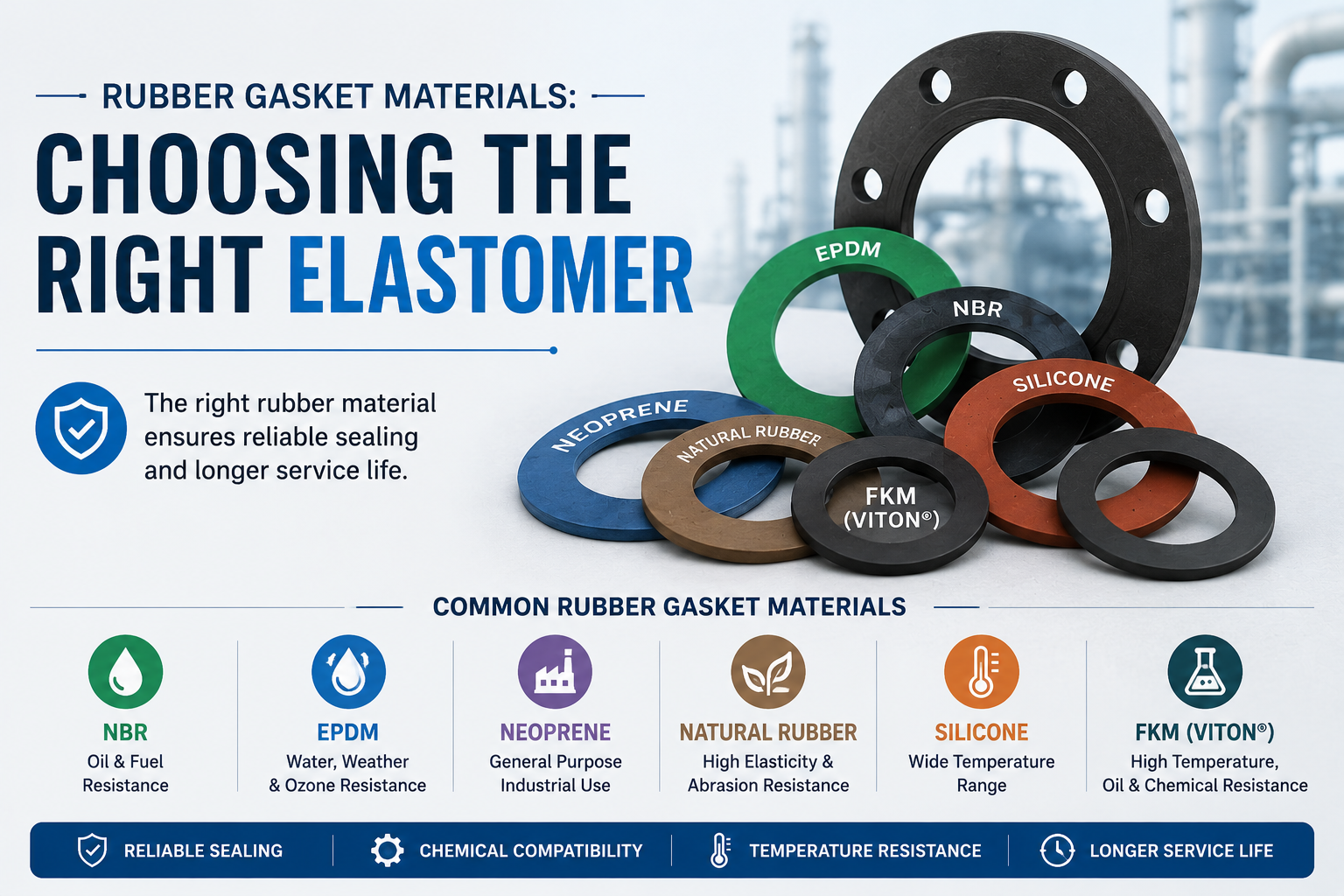
1. Nitrile Rubber (NBR)
Nitrile rubber, commonly known as NBR, is frequently selected for applications involving petroleum-based oils and fuels.
Typical applications may include:
- Oil handling equipment
- Fuel systems
- Pumps and valves
- Hydraulic equipment
- Industrial machinery
- Automotive applications
NBR can provide good resistance to many oils and hydrocarbons, but suitability should always be checked against the actual fluid, temperature, and operating conditions.
2. EPDM Rubber
EPDM is commonly considered for applications involving water, weather exposure, ozone, and certain chemical environments.
Typical applications include:
- Water pipelines
- Water treatment systems
- Outdoor equipment
- HVAC systems
- Pumps and valves
- General industrial applications
EPDM is generally not the preferred choice for petroleum oils and hydrocarbon fuels, so media compatibility should be checked carefully.
3. Neoprene Rubber (CR)
Neoprene, also known as chloroprene rubber or CR, offers a useful balance of properties for many general industrial applications.
Depending on the grade and service conditions, it may be considered for:
- Industrial machinery
- HVAC equipment
- Water applications
- Outdoor installations
- Pumps
- Flange connections
Its suitability should be confirmed according to temperature, pressure, media, and environmental exposure.
4. Natural Rubber (NR)
Natural rubber is known for its flexibility, elasticity, and resistance to abrasion in suitable applications.
It may be used in:
- Water services
- General-purpose sealing
- Industrial equipment
- Abrasion-related applications
- Low to moderate duty sealing systems
Natural rubber is not universally suitable for oils, fuels, strong chemicals, or elevated temperatures, so application conditions need to be evaluated.
5. Silicone Rubber
Silicone rubber is often selected where flexibility across a broad temperature range is important.
Applications can include:
- Food-processing equipment where an appropriate compliant grade is specified
- Electrical equipment
- HVAC applications
- Industrial machinery
- Temperature-sensitive sealing applications
Different silicone formulations are available, and compliance requirements should be verified for food, pharmaceutical, or other regulated applications.
6. Viton / FKM
FKM fluoroelastomers are commonly considered for demanding applications involving elevated temperatures, fuels, oils, and various chemicals.
Potential applications include:
- Chemical processing
- Oil and gas equipment
- Fuel systems
- Industrial machinery
- Process equipment
- High-demand sealing applications
FKM materials are generally more specialized and can cost more than common elastomers such as NBR or EPDM. Selection should be based on service requirements rather than price alone.
How to Choose the Right Rubber Material
There is no single rubber gasket material that is best for every industrial application. Selection should begin with the actual operating environment.
Consider these key factors:
- Process fluid or gas
- Chemical compatibility
- Operating temperature
- Operating pressure
- Exposure to oils or fuels
- Outdoor and weather exposure
- Ozone resistance
- Required hardness
- Gasket thickness
- Flange design
- Applicable standards
- Regulatory requirements, where applicable
For critical applications, material compatibility and engineering requirements should be reviewed before final selection.
Quick Elastomer Selection Guide
| Elastomer | Common Selection Considerations | Typical Applications |
|---|---|---|
| NBR | Oils and fuels | Oil systems, machinery, hydraulics |
| EPDM | Water, weather and ozone | Water systems, HVAC, outdoor use |
| Neoprene / CR | General-purpose industrial service | Machinery, HVAC, pumps |
| Natural Rubber | Elasticity and abrasion resistance | Water and general industrial use |
| Silicone | Broad temperature flexibility | Food-grade*, HVAC, electrical |
| FKM | Oils, fuels, heat and various chemicals | Chemical, fuel and demanding industrial service |
*The specific silicone grade must meet the applicable regulatory requirements.
Chemical Compatibility Matters
Choosing an elastomer only by temperature or price can result in poor gasket performance.
The gasket material may swell, harden, soften, crack, or otherwise deteriorate when exposed to an incompatible process medium.
When evaluating compatibility, consider the specific chemical, concentration, temperature, exposure duration, and operating conditions rather than relying only on the general name of the fluid.
Temperature and Pressure Requirements
Temperature can significantly affect elastomer properties. A material suitable at ambient temperature may behave differently at elevated or very low temperatures.
Pressure is also important, but gasket performance depends on more than system pressure alone. Flange design, bolt loading, gasket thickness, material hardness, surface condition, and joint design can all influence sealing performance.
Gasket Hardness and Thickness
Rubber materials are available in different hardness levels, commonly expressed using Shore A hardness.
A softer gasket may conform more readily to certain surfaces, while a harder compound may provide different mechanical characteristics.
Similarly, thicker is not automatically better. Gasket thickness should be selected according to joint design, flange condition, material properties, and application requirements.
Information to Provide When Ordering Rubber Gaskets
For accurate product selection and quotation, buyers should provide:
- Rubber material or required grade
- Gasket dimensions
- Thickness
- Hardness, if specified
- Operating temperature
- Operating pressure
- Process media
- Quantity
- Applicable standard
- Drawing for custom profiles
- Required certifications or compliance
- Delivery destination
Providing these details helps the supplier review both technical and commercial requirements more accurately.
Conclusion
Selecting the right rubber gasket requires matching the elastomer to the actual application.
NBR is commonly considered for oils and fuels, EPDM for water and weather-resistant applications, Neoprene for many general industrial uses, Natural Rubber where elasticity and abrasion resistance are important, Silicone for suitable temperature-sensitive applications, and FKM for more demanding chemical, fuel, and temperature conditions.
Final material selection should always consider the complete combination of media, temperature, pressure, gasket dimensions, flange conditions, standards, and application requirements.
Need More Information About Rubber Gasket Materials: Choosing the Right Elastomer
Share your technical requirement, application, quantity and destination with our export team for product and commercial review.
Send Application Details
Spiral Wound Gasket
Looking for a reliable sealing solution that performs flawlessly under extreme pressure and temperature conditions? VictoriousWorks offers top-quality Spiral Wound Gaskets designed for superior sealing integrity and long-lasting durability. Engineered with precision using a combination of metallic and non-metallic materials, our gaskets ensure outstanding resilience, flexibility, and performance across diverse industrial applications.
View ProductVictorious Works
Industrial gasket and sealing solution information for international B2B buyers, distributors, OEMs and procurement professionals.