Spiral wound gaskets are widely used for sealing flanged joints in piping systems, pressure vessels, heat exchangers, boilers, and other industrial equipment.
Spiral wound gaskets are widely used for sealing flanged joints in piping systems, pressure vessels, heat exchangers, boilers, and other industrial equipment. Their combination of metallic windings and soft filler material helps provide reliable sealing under demanding pressure and temperature conditions.
However, choosing the right spiral wound gasket requires more than simply matching the gasket diameter to the flange. Material compatibility, flange standard, operating temperature, pressure, filler material, and gasket construction all need to be considered.
This guide explains the key factors to evaluate when selecting a spiral wound gasket for an industrial application.
What Is a Spiral Wound Gasket?
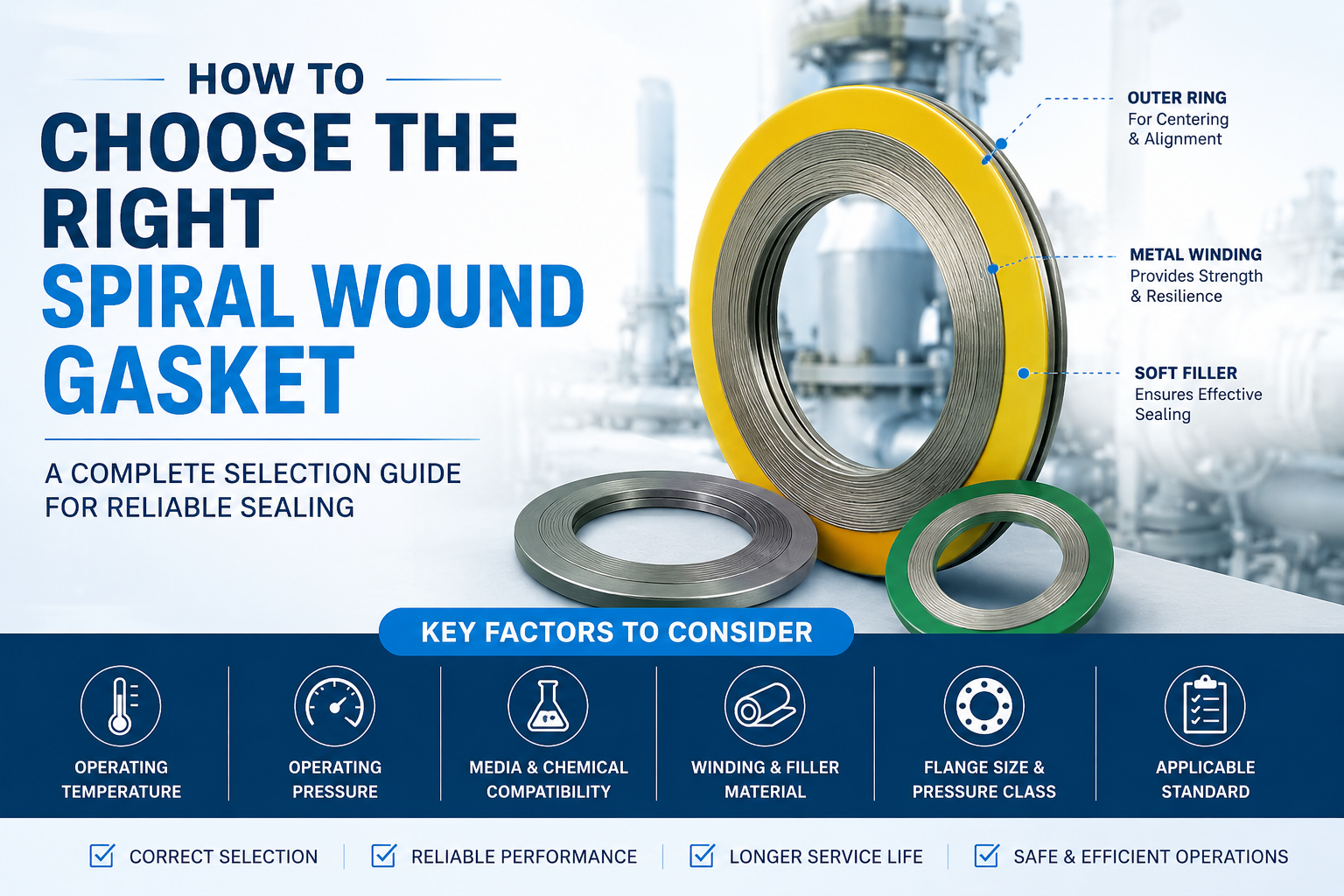
A spiral wound gasket is manufactured by winding alternating layers of a formed metal strip and a soft filler material into a circular sealing element.
The metallic winding provides strength and resilience, while the filler contributes to sealing performance. Depending on the design, a spiral wound gasket may also include an inner ring, outer centering ring, or both.
These gaskets are commonly selected for applications where operating conditions can make conventional soft gaskets unsuitable.
1. Identify the Operating Temperature
Temperature is one of the first factors to consider when selecting a spiral wound gasket.
The gasket materials must remain suitable throughout the expected operating temperature range. Both the metallic winding material and filler need to be evaluated.
Common filler materials include:
- Flexible graphite
- PTFE
- Ceramic-based materials for suitable high-temperature applications
Do not select a gasket based only on its dimensions. A gasket that physically fits the flange may still be unsuitable for the operating temperature.
2. Consider the Operating Pressure
The gasket must also be appropriate for the pressure conditions of the piping or equipment.
Consider both normal operating pressure and any expected pressure fluctuations. The flange class, gasket dimensions, materials, and construction should correspond with the requirements of the system.
For critical services, gasket selection should be based on the applicable engineering specification rather than pressure alone.
3. Check Media and Chemical Compatibility
The fluid or gas passing through the system can directly affect gasket material selection.
Before choosing a gasket, identify the process media, such as:
- Water
- Steam
- Oil
- Gas
- Chemicals
- Acids or alkaline media
- Hydrocarbons
- Other process fluids
The winding and filler materials should be compatible with the process medium under the actual operating conditions.
Chemical compatibility should always be evaluated together with temperature and concentration because material performance can change significantly under different service conditions.
4. Select the Appropriate Winding Material
The metallic winding is an important structural component of a spiral wound gasket.
Depending on the application and specification, materials may include stainless steels and other suitable alloys.
The correct winding material depends on factors such as corrosion resistance, temperature, process media, and the materials used in the connected equipment.
For export or project requirements, buyers should clearly specify the required material grade rather than relying only on a generic description such as “stainless steel gasket.”
5. Choose the Correct Filler Material
The filler sits between the metallic winding layers and plays an important role in sealing.
Flexible graphite is commonly considered for many industrial services because of its sealing characteristics and suitability across a broad range of applications.
PTFE may be considered where chemical resistance is an important requirement, subject to the application's temperature, pressure, and other operating conditions.
Other specialized filler materials can be specified for particular services.
The filler should therefore be selected according to the complete operating environment rather than cost alone.
6. Determine the Required Gasket Construction
Spiral wound gaskets are available in different configurations.
Depending on the flange design and applicable standard, a gasket may be supplied as a winding-only element or with inner and/or outer rings.
An outer centering ring can assist with positioning the gasket within the flange assembly.
An inner ring may be specified for certain flange classes, services, standards, or operating conditions and can provide additional support to the gasket assembly.
The required construction should be confirmed against the relevant flange and gasket specification.
7. Confirm Flange Size and Pressure Class
Accurate flange information is essential before ordering.
Typical information includes:
Nominal Pipe Size (NPS/DN): Identifies the nominal size of the piping system.
Pressure Class: Specifies the applicable flange pressure rating or class.
Flange Type: For example, raised-face or another applicable flange configuration.
A gasket should not be selected based only on its outside diameter. The complete flange specification should be provided.
8. Check the Applicable Standard
Industrial projects frequently require gaskets manufactured according to specific dimensional or material standards.
Depending on the project and market, the applicable specification may define gasket dimensions, construction, materials, identification, and other requirements.
For international supply, clearly stating the required standard helps reduce the risk of dimensional or specification mismatches.
Purchase enquiries should therefore include the standard and edition where required by the project.
9. Consider Flange Condition and Installation Requirements
Even a correctly specified gasket may perform poorly if the flange assembly or installation is unsuitable.
Before installation, flange sealing surfaces should be checked for issues such as damage, contamination, excessive corrosion, or misalignment.
Fasteners and tightening procedures also matter. Appropriate bolt loading should be applied according to the engineering requirements of the joint.
A spiral wound gasket should generally be treated as a sealing component intended for proper installation rather than as a way to compensate for damaged or incorrectly aligned flanges.
10. Provide Complete Information When Requesting a Quote
Providing complete technical details helps manufacturers and suppliers identify the correct gasket more efficiently.
For a spiral wound gasket enquiry, consider providing:
- Gasket or flange size
- Pressure class
- Applicable standard
- Flange type
- Winding material
- Filler material
- Inner ring requirement and material
- Outer ring requirement and material
- Operating temperature
- Operating pressure
- Process media
- Required quantity
- Delivery destination
- Any project-specific specification or drawing
If available, a technical drawing, datasheet, or existing gasket specification can also help clarify the requirement.
Common Mistakes to Avoid
One of the most common mistakes is selecting a spiral wound gasket purely by size. Two gaskets with similar dimensions may have completely different materials, construction, pressure classes, or intended applications.
Other mistakes include choosing an incompatible filler, ignoring process media, providing incomplete flange information, overlooking the required standard, and assuming one gasket construction is suitable for every flange.
Careful specification at the enquiry stage can prevent many of these problems.
Selecting Spiral Wound Gaskets for Export Orders
Export orders often require additional attention because products may need to meet customer-specific specifications, international standards, documentation requirements, packaging requirements, and project schedules.
Buyers should provide as much technical information as possible with the initial enquiry. This allows the supplier to review the requirement before production and confirm the relevant product specification.
For bulk requirements, a structured list containing size, class, material, quantity, and standard is particularly useful.
Conclusion
Choosing the right spiral wound gasket requires a balanced review of size, flange class, temperature, pressure, process media, winding material, filler material, gasket construction, and applicable standards.
Instead of selecting a gasket based only on dimensions or price, start with the actual operating conditions and flange specification. For critical or specialized applications, the final selection should be reviewed by the responsible engineer or technical authority for the system.
Providing complete technical details at the enquiry stage also makes it easier to obtain the correct product, quotation, documentation, and delivery information for domestic or international supply.
Need More Information About How to Choose the Right Spiral Wound Gasket
Share your technical requirement, application, quantity and destination with our export team for product and commercial review.
Send Application Details
Spiral Wound Gasket
Looking for a reliable sealing solution that performs flawlessly under extreme pressure and temperature conditions? VictoriousWorks offers top-quality Spiral Wound Gaskets designed for superior sealing integrity and long-lasting durability. Engineered with precision using a combination of metallic and non-metallic materials, our gaskets ensure outstanding resilience, flexibility, and performance across diverse industrial applications.
View ProductVictorious Works
Industrial gasket and sealing solution information for international B2B buyers, distributors, OEMs and procurement professionals.